 There has been quite a debate about whether Samuel Coleridge-Taylor was, or was not, financially comfortable as a child and young man. Jeffrey Green‘s meticulous research, for instance, has established that Coleridge-Taylor’s grandfather / father-figure, Benjamin Holmans, was a man of significant wealth, having two electoral votes (as was then the rule) because he paid rent on two Croydon properties.
Nonetheless, there are still those who suppose that in his youth Samuel (‘Coleridge’, as he was then known) was by no means well off – albeit we see from his posthumous estate that later in his short life he acquired a more substantial financial status. 
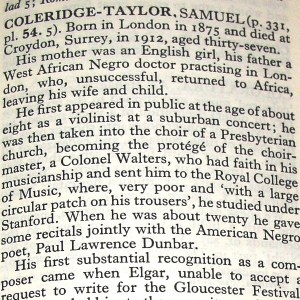
In such a context this entry [picture] in the 1955 edition of The Oxford Companion to Music is interesting.
Yes, we do have first to concede that there is in the non-PC text poetic licence in the account of how and why Samuel’s biological father was nowhere to be seen, but in 1955 such glossing over of illegitimacy and the like was not unusual.
What is more striking is the unsourced quote we see here about Coleridge-Taylor attending the Royal College of Music ‘with a large circular patch on his trousers’, this being cited as evidence of serious poverty. One gathers trouser patches were not the norm at the RCM even back in the early 1890s.
So when and from where, we are left to wonder, did this quote emanate? Does anyone know the source of the report? And why apparently was it felt at the time to be a significant observation?
How does this fit with the RCM sponsorship claimed in the OCM entry on behalf of Colonel Herbert Walters?
And how does it fit with Jeffrey Green’s report that the continued involvement of Alice’s mother Emily Ann Martin – according to Bill Greenwell probably the Holman’s housekeeper when the family had previously lived in Kent – was important? Emily continued to visit her daughter Alice (who later raised a family with George Evans) in Croydon into the 1900s, providing money whilst Benjamin Holmans (Snr), very likely Alice’s biological father, provided the home. This grandmaternal support was, Jeffrey Green tells us, crucial in Samuel Coleridge-Taylor’s childhood.
Does then the OCM reference to patched trousers tell us that Samuel was less favourably treated as a family member, at least in cash terms, than others in his relatively comfortable home? Or was there austerity in personal matters in that household as a general rule, perhaps to ensure the success of (the householder) Benjamin Holman’s business?
Or is there another explanation for the trouser patch report, even a romantic, possibly fictional, notion by someone of sacrifice for one’s art?
Maybe Samuel Coleridge-Taylor did for whatever reason experience poverty in his student days, but things improved quite shortly thereafter when paid work came his way as Hiawatha became popular.
But that’s only one suggestion. Others seeing this entry in the 1955 edition of The Oxford Companion to Music may have different views about how accurate the report of the patched trousers is, and what it tells us…


 Samuel Coleridge-Taylor Foundation
Patched trousers and repaired shoes (hence C-T’s hammer toes) were a sign of careful household management according to contemporary memoirs. That a fifteen year old black child raised right next to the railway in Croydon could have qualities inherited from his African ancestors and encouraged by his English ancestors (his English uncle was a professional musician as were two of his cousins) did not fit conventional thinking. The first biography (1915) tried to link poet Taylor Coleridge to the composer, unaware that three generations of the Holmans were musical. The absent African father could have been explained without inventing a failed practice in Croydon due to racism.
There is no evidence that C-T had a ‘relatively comfortable home’ as a child (it lacked servants) but we know that his mother Alice was at school aged 14 and her half-brothers also were educated way beyond the standard age 10 of the 1850s. The Croydon income was from his railway storeman step-father Evans (about £1 a week) and his blacksmith grandfather Holmans, as well as “Aunt” Emma (Emily Martin). Before moving to London the Holmans family had lived in Dover (same home as Emily Martin, C-T’s uterine grandmother) in a poor neighbourhood long demolished (no housekeeper there).
That Dunbar cooperation was in 1897 (C-T was 22). The colonel who has long been regarded as C-T’s patron was actually a silk merchant in London who was an officer in the militia, a dozen years younger than C-T: but helpful to C-T and other young musicians. Not crucial, though.
I hope that my attempts to clarify these and other matters will be seen in the new (mid-2011) biography that Pickering and Chatto of London will soon publish.
Jeffrey Green 13 March 2011.
Many thanks for this, Jeffrey.
May we gather from your comments that Colonel Walters was not a choirmaster in Croydon when SC-T was a child, but, rather, that Walters came onto the scene at a later stage?
Please do keep us posted about news of your book and its publication date.
I think a bit of a typo infected Jeff’s comments on Col Walters. As I understand it Walters was in his twenties when he first met Coleridge Taylor and was therefore about 15 years older than SCT. Although he did make some financial contribution to Coleridge’s fees at the RCM his real value as a mentor was his connections in the London musical world.
Well done Mick – I meant to say a dozen years older. So the “Colonel” when he was a Croydon choirmaster in 1885 would have been 22 and SC-T 10.
And when SC-T went to the College in 1890 aged 15 the “Colonel” would have been 27 or so.
Jeff Green
I happened upon this site per chance while doing some family research. I see the newspaper article says that his father Dr Daniel Taylor left his wife and child and returned to Africa. Alice and the good doctor were never married and he didn’t even know that she was pregnant. He left due to racism resulting in the failure of his practice. In Africa he excelled and was later appointed Corona of the Colony. He married and had another lineage from which l descended.
Grace Coleridge-Taylor
Dear Grace,
I would respond privately but unfortunately you haven’t left contact details, so whilst it’s good now to be in touch I remain very unclear why you weren’t previously aware of this website. We have been researching and promoting Samuel Coleridge-Taylor, entirely as volunteers, for about thirty years, and have in that time had contact both, closely, with the Dashwood ‘side’ of the family and, on various occasions with the Coleridge-Taylor ‘side’, always inviting the C-Ts to stay in touch, though none has till now done so.
You are correct, as is clearly stated in the text I wrote here accompanying this newspaper report to which you refer, that Samuel’s parents were never married – but Victorian conventions, as is also explained here, meant at that time the fiction had to be maintained. It is also evident that Dr Taylor was not aware of his son’s impending birth when he (Dr T) left the UK; there is however some question about whether the father did become aware later on and made an attempt to locate him on returning to the UK some decades afterwards. It’s sad, but I guess we will never know definitively.
SC-T was an exemplary exponent of the idea that we should all try to live in harmony, and it is for that reason particularly that many of us, from different backgrounds and ethnicities, have worked hard to promote his legacy as a man of peace as well as an outstanding musician.
I’d be very happy to share more with you, if you would like to send me your contact details.
Thank you and best wishes,
Hilary
There’s a talk by Dr. William Tortolano, Professor at St Michael’s College, Vermont, on this link https://www.youtube.com/watch?v=SNGnnutxJWo where he reads from, and shows an excerpt, from a letter he received from Avril Coleridge Taylor stating that the real mother of Coleridge Taylor isn’t known. It would be fascinating to learn more about the background to this.